documenta (13)
Tue Sep 04 2012
Various projects curated by Joasia Krysa for documenta(13), Kassel
including Erkki Kurenniemi. In 2048, and Constant: Online archive of Erkki Kurenniemi (In 2048)
http://d13.documenta.de/
(2012) After 100 days open to the public the total number of visitors in Kassel was 905,000, amounting to 110,000 additional visitors or a 14% increase from the previous edition of documenta in 2007.
An additional 27,000 people visited the dOCUMENTA(13) exhibition held in Kabul from June 20 to July 19, 2012, bringing the total number of visitors to 887,000.
An exhibition is an unfolding organism, like a vegetable bud. It comes from intuitions, then it forms an instinct, then an opinion, then a knowledge; like a plant—which contains in itself many other living entities—it has roots, buds and fruit. After four years of preliminary encounters, seminars and preparations, after a 100-day exhibition and other activities in Kassel, a series of seminars and a 30-day exhibition in Kabul, an 8-day seminar in Alexandria, and a 14-day retreat in Banff, dOCUMENTA (13) closed in Kassel on Sunday, September 16, 2012, at 8 pm. On June 9, 2012, when the exhibition opened in Kassel, we said that dOCUMENTA (13) was dedicated to artistic research and forms of imagination that explore commitment, matter, things, embodiment, and active living in connection with, yet not subordinated to, theory. We said these were terrains where politics are inseparable from a sensual, energetic, and worldly alliance between current research in various scientific and artistic fields and other knowledges, both ancient and contemporary, and that dOCUMENTA (13) was driven by a holistic and non-logocentric vision that is skeptical of the persisting belief in economic growth, a vision that is shared with, and recognizes, the shapes and practices of knowing of all the animate and inanimate makers of the world, including people. And now we add that an exhibition could be thought of as a pre-reflexive consciousness, a qualitative duration of consciousness without itself. A bliss able to go beyond the aporias of the subject and the object—an experience of life no longer dependent on the first, nor submitted to the latter. Art is ceaselessly posed in life. And this indefinite life posed in art allows us to grasp the lived and living, to understand life as carried by the events, and by the singularities actualized in subject/objects. Art does not just come after life, but rather it offers the immensity of a temporality constituting spaces where one sees the event yet to come in the absolute of an immediate consciousness.
For the second time since 1997, documenta 2012 was directed by a woman. Carolyn Christov-Bakargiev, who gathered around her an advisory circle of “agents” from around the world, most notably the Spaniard Chus Martínez, confused the press in the run-up with non-concept, eco-feminism, dog calendars, an absurdly hard-to-remember title The dance was very frenetic, brisk, rattling, ringing, rolling, twisted, and lasted a long time, as well as the announcement of a parallel exhibition in Kabul, Afghanistan.
Following the platforms of documenta 11, documenta 13 went one step further by not only organizing events outside Kassel in the run-up to the exhibition, but for the first time also part of the exhibition itself during its duration. However, another location was initially important for the concept: the former Benedictine monastery Breitenau outside Kassel, which had housed a labor and concentration camp under the National Socialists and later a girls’ educational home and a psychiatric institution.
Between these two locations, Kassel/Breitenau and Kabul/Bamiyan, documenta 13 established a main motif that in turn tied in with the original idea of documenta: “Collapse and Recovery” - in other words, the healing of war trauma through art. Many artists (all of whom had visited Kassel and Breitenau beforehand, some also Kabul and Bamiyan) referred to these places in the almost exclusively newly produced works - such as Omer Fast, Mariam Ghani, Goshka Macuga, Michael Rakowitz and Clemens von Wedemeyer. Workshops were also held in Kabul and Bamiyan, the results of which were incorporated into an exhibition of Afghan artists in Kassel.
While the exhibition in Kabul was seen by 27,000 visitors, the events in Cairo/Alexandria and Banff were largely closed to the public. Christov-Bakargiev associated these four locations with further states of existence that oscillated between them and became programmatic for documenta 13: On Stage (Kassel), Under Siege (Kabul), Hope and Revolt (Cairo and Alexandria) and Retreat (Banff).
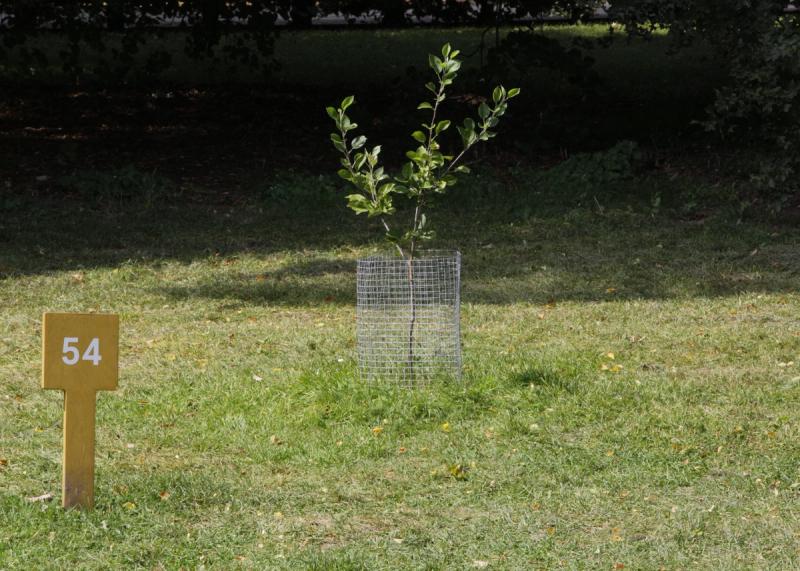
The structures were also broken up in terms of time: documenta 13 officially began back in May 2010 with the erection of Giuseppe Penone’s Idee di Pietra (Ideas of Stone) (2003/2008/2010), a bronze tree with an erratic boulder in its crown in the Karlsaue. This was a reference to Christov-Bakargiev’s own roots in Arte Povera. The motif of planting trees, closely associated with documenta since Beuys, reappeared in other moments of the exhibition in the works of Korbinian Aigner and Jimmie Durham. Last but not least, anti-anthropocentrism was another important theme of documenta 13: seeds, apples and dogs were just as much a part of it as people and art.