Stages Journal
Stages is an open-access, contemporary art journal for staging research generated in the context of Liverpool Biennial's artistic programme. Stages journal brings together ideas and projects that emerged from public programmes of the Liverpool Biennials.
Stages #8
Beautiful world, where are you?
This volume brings together ideas and projects that emerged from the public programme of the 10th anniversary edition of Liverpool Biennial (July-October 2018), responding to a line from the poem The Gods of Greece by German poet Friedrich Schiller (1759–1805): ‘Beautiful world, where are you?‘ The line evokes the lost grandeur, beauty and meaning embodied by mythical Greece, translated to our contemporary not-so beautiful reality.
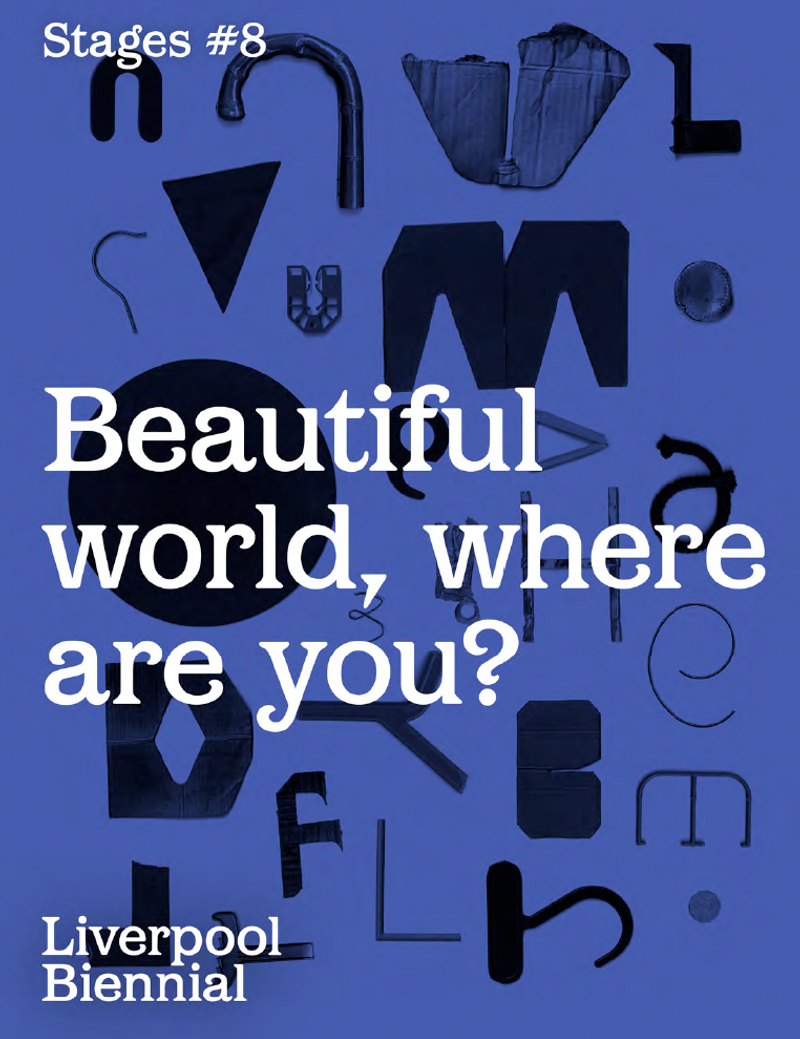
At irregular intervals between May and October 2018, an eclectic list of speakers from fields as diverse as economics, biology, linguistics, media theory, architecture and painting were invited to directly address or indirectly refract Schiller’s question, as part of the new programme of talks curated for Liverpool Biennial 2018 by The Serving Library.[2] Designed to run in parallel with exhibitions and projects elsewhere in the city, the programme was presented at Exhibition Research Lab[3] alongside The Serving Library’s collection and an installation of Paul Elliman’s new work commissioned for Liverpool Biennial 2018 entitled Vauxhall Astra 2020.[4] Developed and expanded from this initial context, the contributions to this volume include Morehshin Allahyari in conversation with Christiane Paul, as well as from Ryan Avent, Jessica Coon, Meehan Crist, Candice Hopkins, Mark Miodownik, Jussi Parikka, Alexander Provan, Forensic Architecture (presented in the talks programme by Eyal Weizman) and Paul Elliman, whose graphic identity for Liverpool Biennial 2018 is represented in the cover image. The volume is conceived by Joasia Krysa.
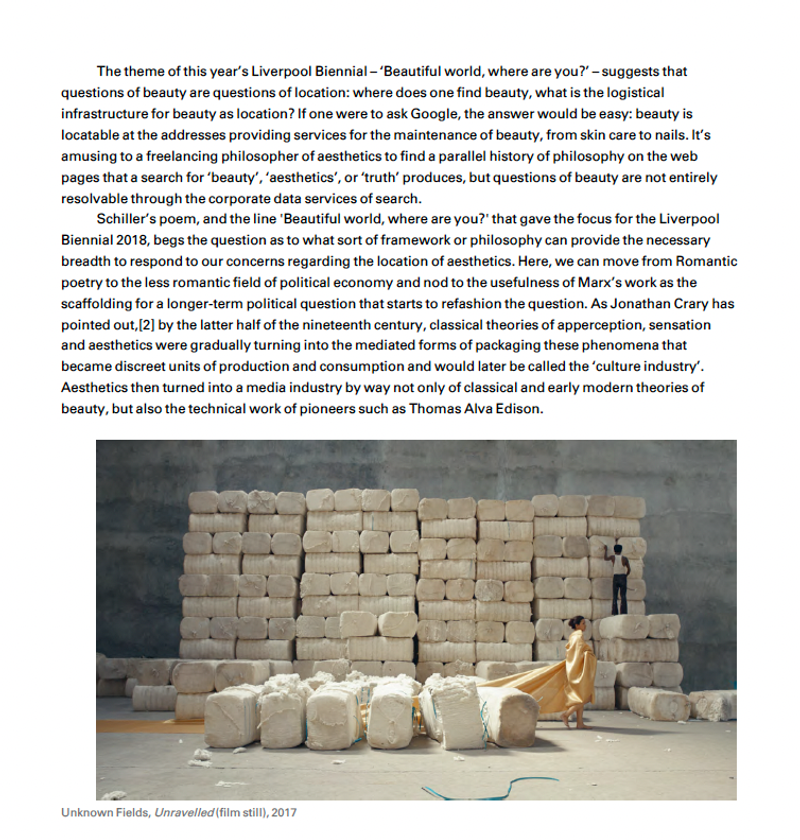
The volume opens with Jussi Parikka’s text ‘Beauty: A Logistical Imaginary’ that introduces a discussion of the location of beauty and aesthetics – from the theories of Karl Marx and Theodore Adorno to Max Horkheimer’s ‘Culture Industry’ and Frederic Jameson’s writings on postmodernism, to Ned Rossiter’s ideas connecting software, labour and logistics today. Parikka goes on to focus on the recent film Unravelled 2017 by Unknown Fields Division, ‘a nomadic design research studio that ventures out on expeditions to the ends of the earth to bear witness to alternative worlds, alien landscapes, industrial ecologies and precarious wilderness’.[5] The film serves as a case study to unpack the logistical infrastructures of production and circulation of beauty through the lens of the fashion industry, tracking ‘the movement of bodies, movement of images and the movement of beauty as products across the geographical locations of the planet’.
In the edited excerpt from her talk ‘Climate Grief and the Visible Horizon’ (2018), Meehan Crist takes the story of Phaethon and Phoebus from Ovid’s Metamorphoses as a metaphor for climate change. But unlike in the more obvious reading (as in Ted Hughes poem), where the boy, Phaethon, depicts ‘human hubris and a desire to take control of a thing that was never meant to be ours and running the world into destruction’, for Crist, the attention shifts to ‘marginalised people who aren’t the ones responsible for the destruction they’re seeing and living through but who ultimately remain voiceless’. She asks: ‘What does it feel like to witness that kind of destruction?’ at a time when ‘collectively and individually we’re experiencing what no generation of humans has ever faced, which is grieving the on-going loss of the planet as we’ve known it’.
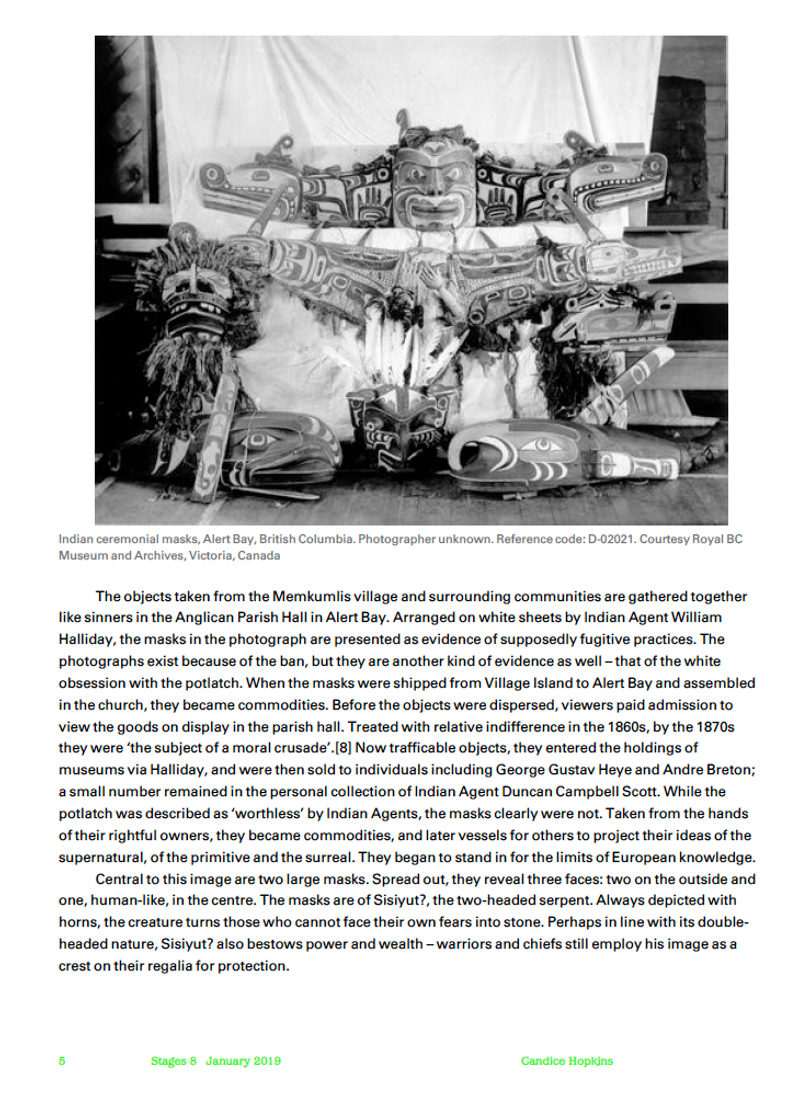
Marginalised people – those who have only recently begun to gain a voice – is also the subject of Candice Hopkins’s text ‘Outlawed Social Life?’ (originally published in 2016 in The South as a State of Mind magazine in connection with Documenta 14, Athens/Kassel 2017) that became the basis for her subsequent presentation for Liverpool Biennial 2018 entitled ‘Native Economies: from the Potlatch Ban to the Masks of Beau Dick’. Here, she focuses on Native people of Canada, and the complex stories that their objects such as masks and regalia tell as well as discussing social structures and governance, communities of sharing, of language and law, cultural and economic value, forms of control and inherent resistance, transformation and survival.
In ‘Re-figuring Ourselves’, curator Christiane Paul and artist Morehshin Allahyari discuss her works Material Speculation: ISIS (2015–16) and the series SHE WHO SEES THE UNKNOWN (2017–present), both responding to the cultural and political context of recent events in the Middle East. The latest work in the Allahyari’s series SHE WHO SEES THE UNKNOWN, entitled The Laughing Snake was co-commissioned for Liverpool Biennial 2018 with The Whitney Museum of American Art and FACT (Foundation for Art and Creative Technology). The conversation explores the works in terms of modes of archiving and documentation, engagement with the materiality of artefacts and figures, the recreation and reinvention of material forms and bodies (re-figuration), and ultimately activation and preservation – retrieving forgotten or destroyed stories. Employing 3D scanning and printing to recreate dark goddesses and monstrous female figures of Middle-Eastern origin, the latest work The Laughing Snake, uses the traditions and myths associated with them to offer what Allahyari describes as a ‘ficto-feminist and activist practice to reflect on the effects of historical and digital colonialism and other forms of oppression and catastrophe’ in contemporary societies.
Forensic Architecture is both the name of an agency established in 2010 at Goldsmiths, University of London, and a form of investigative practice into state violence and human rights violations that traverses architectural, journalistic and legal fields.[6] The contribution here entitled ‘Forensic Aesthetics’ is derived from the talk delivered by Eyal Weizman for Liverpool Biennial 2018 and expanded by extracts from the Forensic Architecture website. It catalogues briefly four projects that serve to unpack the term ‘forensic aesthetics’, one of several key concepts that underlie the group’s approach, and the technologies of weapons and tools of recording.
The question of technologisation and industrialisation, advances in science and technology, and the ultimate sense of loss of meaning and mystery in the world are the subject of Ryan Avent’s ‘Technology, Magic and the Quest for Meaning’ (2018). In his abstract, while ‘today's advances in Artificial Intelligence mean that much of how technology will work in the future is entirely mysterious to all but a few experts, […] creating spirited creatures, like cars that drive themselves and robots that walk among us’ is not necessarily dystopian and there are perhaps ways to turn it into something beautiful and affirming, too.
Mark Miodownik’s contribution ‘Self-Repairing Cities’ reviews the science behind new understandings of matter, and material technologies resulting from blurring the distinction between animate and inanimate in a new materials age: ‘Bionic people with synthetic organs, bones and even brains are becoming a reality. Just as we are becoming more synthetic, so our man-made environment is changing to become more lifelike: buildings, objects and materials that heal themselves are being developed. The question then becomes whether … creating self-repairing cities is achievable.’
Jessica Coon’s ‘Alien Speaks’,[7] based around the recent science-fiction film ARRIVAL, touches on speculative and real questions: if aliens arrived, could we communicate with them? How would we do it? What are the tools that linguists use to decipher unknown languages? How different can human languages be from one another? These questions attempt to offer another set of tools to understand the world through the lens of the linguist.
Following the thread of language and communication, Alexander Provan presents what can be described simply as a playlist – a list of chart-toppers, with their lyrics and number of spotify plays, as a response to the question: why (more) Katy Perry? His ‘Outside the Hit Factory: The Playlist’, originally presented as performance talk, serves to reflect on the use of consumer-behaviour data and neurobiology research in the production of pop songs to guarantee pleasing as many listeners as possible.
Finally, this volume’s cover image draws upon the work of Paul Elliman, who worked with Sara De Bondt and Mark El-Khatib on the graphic identity of Liverpool Biennial 2018. It is based on letter-like shapes and symbols gathered as part of a durational work – a ‘found font’ – what Elliman calls The Day Shapes.[8] Like these shapes on its cover, the diverse contributions in this volume offer a snapshot of a current state of things – the world that is complex and unpredictable, entangled and fragmented, in turmoil – yet with some sense of hope emerging from the chaos.
Stages #7
Notes on Design & Empire
"Empire is materialising before our very eyes."
(Hardt & Negri, Empire, 2000)
Liverpool established its international reputation as a pre-eminent gateway for shipping, trade and the movement of people in multiple, sometimes troubling, ways. The city created to service this exchange – dense in buildings, public spaces and infrastructure, financed with colonial profits – became a major port of the British Empire. Today, Liverpool presents an even more complex story, having undergone serious decline since the industrial period, followed by intense regeneration when it became European Capital of Culture in 1998, and now part of the ‘Northern Powerhouse’.
Set against this backdrop, with Liverpool as both subject and stage, the Design & Empire [working title] symposium challenged some of the aspects of Liverpool’s imperial legacy whilst reflecting on wider current practices within design and visual culture. How does one reflect the other? How does Empire materialise in contemporarycultural practices? How can we discuss this without becoming part of the problem?
Michael Hardt and Antonio Negri’s seminal book Empire seems to provide some clues. To the authors, Empire is a 'decentered and deterritorializing apparatus of rule that progressively incorporates the entire global realm within its open, expanding frontiers. Empire manages hybrid identities, flexible hierarchies, and plural exchanges through modulating networks of command.’[1]
Today’s Empire, then, as opposed to previous imperialist forms, develops out of changed (and changing) economic and cultural exchanges. Rather than working through nation-states, Empire takes new networked forms and requires no fixed or territorial centre of power. No nation state, not even the USA, holds such a pivotal position today as was maintained by the Roman or the British Empires, for example, and Brexit can be explained as a symptom of this perceived impotence. In this new world order, the periphery and centre are thoroughly embedded in each other. Any major city provides evidence of this, not least Liverpool.
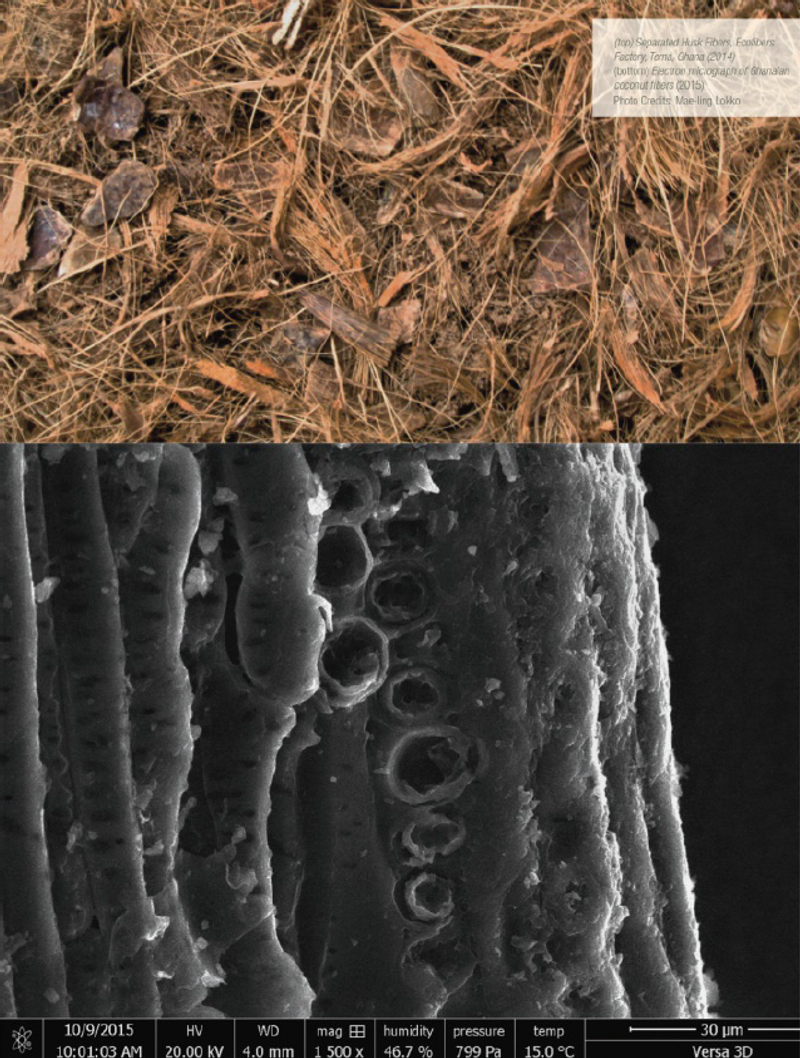
Conceived by curators Emily King and Prem Krishnamurthy, and presented by Liverpool Biennial and Liverpool John Moores University’s School of Art and Design over three days in November 2017, Design & Empire [working title] brought together leading creative voices from the fields of art, design, architecture and fashion to discuss some of these paradoxes of power. Framed by guided city tours exploring Liverpool’s architectural past, and the cooking and serving of a colonial-style Christmas Pudding, it featured conversations on topics ranging from national identity to the display of museum collections, postcolonial approaches to contemporary fashion, copying within creative manufacturing, the reuse and revaluation of bio-industrial materials, and the politics of computer interfaces in relation to the new networked forms of empire.
Stages #6
The Biennial Condition
This issue presents the proceedings from Liverpool Biennial’s 2016 conference The Biennial Condition: On Contemporaneity and the Episodic that took place in Liverpool in October 2016.[1] Drawing directly on the conference, it brings together the curatorial thinking behind the 2016 Biennial with ideas from Aarhus University’s research project The Contemporary Condition.[2] It aims to reflect on biennials both as the privileged site for the production of contemporaneity in art and exhibition making, and as episodic instances of contemporary art on a global scale.
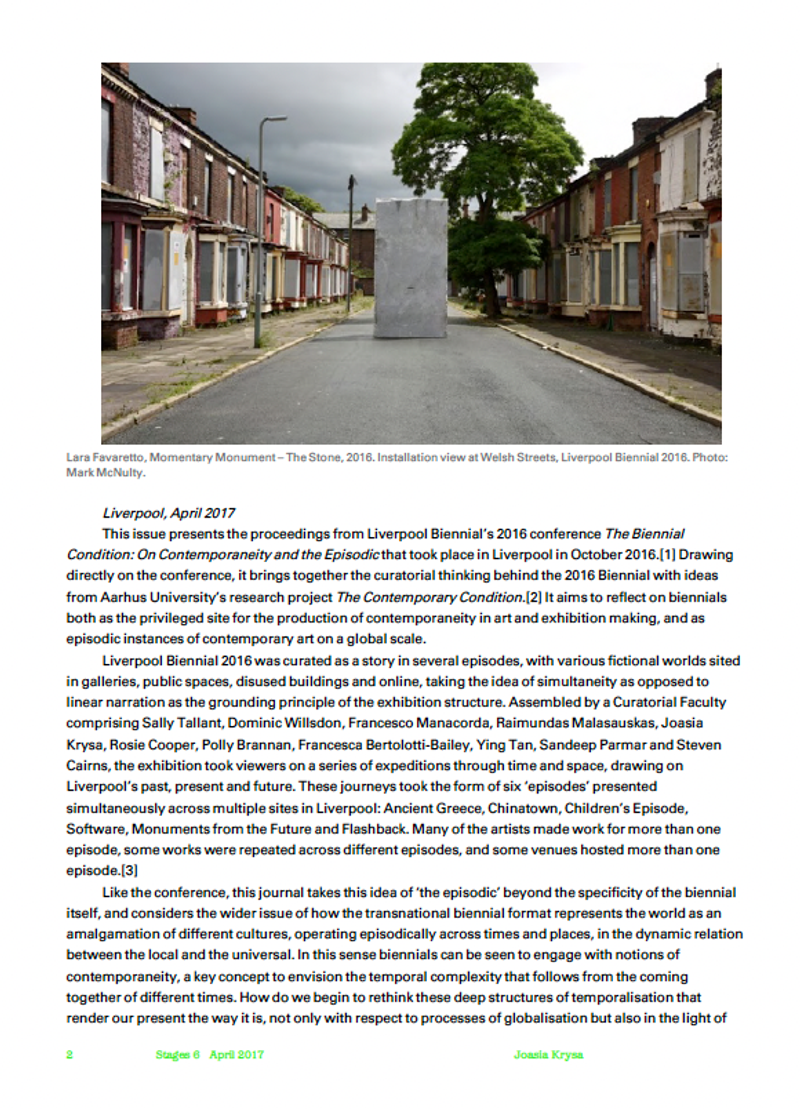
Liverpool Biennial 2016 was curated as a story in several episodes, with various fictional worlds sited in galleries, public spaces, disused buildings and online, taking the idea of simultaneity as opposed to linear narration as the grounding principle of the exhibition structure. Assembled by a Curatorial Faculty comprising Sally Tallant, Dominic Willsdon, Francesco Manacorda, Raimundas Malasauskas, Joasia Krysa, Rosie Cooper, Polly Brannan, Francesca Bertolotti-Bailey, Ying Tan, Sandeep Parmar and Steven Cairns, the exhibition took viewers on a series of expeditions through time and space, drawing on Liverpool’s past, present and future. These journeys took the form of six ‘episodes’ presented simultaneously across multiple sites in Liverpool: Ancient Greece, Chinatown, Children’s Episode, Software, Monuments from the Future and Flashback. Many of the artists made work for more than one episode, some works were repeated across different episodes, and some venues hosted more than one episode.[3]
Like the conference, this journal takes this idea of ‘the episodic’ beyond the specificity of the biennial itself, and considers the wider issue of how the transnational biennial format represents the world as an amalgamation of different cultures, operating episodically across times and places, in the dynamic relation between the local and the universal. In this sense biennials can be seen to engage with notions of contemporaneity, a key concept to envision the temporal complexity that follows from the coming together of different times. How do we begin to rethink these deep structures of temporalisation that render our present the way it is, not only with respect to processes of globalisation but also in the light of micro-temporality, planetary computation, and artistic practices?
This journal features diverse contributions that attempt to address these questions, from a range of curators, artists and researchers. Part of the Liverpool Biennial 2016 Curatorial Faculty, Raimundas Malasauskas and Francesco Manacorda discuss how the exhibition was designed using polyphony, multiverses, contingency, time travel and repetition as display mechanisms and narratological tools. Building on much of his previous work, art historian, art critic and artist Terry Smith explores biennial exhibitions in terms of what he calls ‘contemporary composition’.[4] Artistic Director of European Capital of Culture Aarhus 2017 and the 2014 Biennale of Sydney, Juliana Engberg reflects on biennials as ‘occurences’ and through the logic of topology in which constituent parts can be seen to be interrelated. As well as providing the cover image for the journal [5], artist duo Elmgreen & Dragset make a visual contribution through documentation of their 2009 curated project The Collectors, to reflect their biennial experiences: from participating as artists to curating the upcoming 15th Istanbul Biennial 2017.[6] Curator Elisa Atangana reflects on her experience of the Kampala Art Biennial 2016 and the issue of mobility as a marker of social change. In a transcript of her conference talk, Marina Fokidis discusses Documenta 14 held in both Athens and Kassel in 2017, and how the sharing of different pasts, presents and futures impact upon the agency of the biennial form. Lastly, in a glossary form that reflects the object of study of their research project The Contemporary Condition, Geoff Cox, Jacob Lund, Anne Kølbæk Iversen and Verina Gfader introduce twelve key concepts (contemporary contemporary; chronophobia; random access memory; real-time; presentism; arrested movement; migration; algo-rhythm; pre-acceleration; iconomy; time stamp and loop).[7]
Taken as a whole, the contributions to this journal do not suggest a unified reading or narrative, but rather a coming together of diverse positions that draw upon experiences of encountering contemporary art and the complexity of its temporal conditions, in which biennials play no small part.
Launched in 2013, Stages is developed in partnership with Liverpool John Moores University’s Exhibition Research Lab, and is freely available both online and in PDF format.
Commissioning Editor
Joasia Krysa
Published by
Liverpool Biennial
ISSN 2399-9675